
If you have been wondering when artificial intelligence would start being used against you well the answer, according to Google, is already now. This week, Google’s Threat Intelligence Group released one of the most alarming cybersecurity reports of that describes AI Hacking in 2026. The findings confirmed what many IT professionals have feared: hackers are no longer experimenting with AI. They have operationalized it. And the scale, speed, and sophistication of what they are doing should have every person from casual smartphone users to enterprise IT teams paying close attention.
As an IT specialist who works with Microsoft Teams and enterprise technology daily, I want to break this down in plain language, explain what it means for you personally and professionally, and give you a practical action plan you can implement today.

What Google Actually Found
Google’s Threat Intelligence Group (GTIG) published their findings on May 11, 2026, and the report covers several months of tracking AI-assisted cybercriminal activity. The headline finding is significant: for the first time, GTIG identified a threat actor using a zero-day exploit that they believe was developed with AI, with the criminal threat actor planning to use it in a mass exploitation event but Google’s proactive counter-discovery may have prevented its use.
A zero-day exploit is a software vulnerability that developers do not yet know about — meaning there is no patch available and victims have no warning. Historically, finding and weaponizing a zero-day required deep technical expertise and significant time investment. AI has changed that equation dramatically.
The developments described by Google point to a shift in pace and volume, with AI enabling attackers to iterate faster and potentially broaden the reach of campaigns that once required more time and specialized skill.
In other words: tasks that used to take a skilled hacker weeks can now be done in hours with AI assistance.
The Three Scariest Findings From the Report
1. AI-Written Malware That Bypasses Two-Factor Authentication
Google based its assessment on characteristics common in AI-generated code, including overly explanatory comments in the code, a made-up severity rating for the bug, and coding patterns commonly seen in AI-generated Python scripts. The target was a two-factor authentication bypass on a widely used open-source platform meaning if the attack had succeeded, millions of accounts protected by 2FA could have been compromised simultaneously. Source: Axios
This is significant because many people and organizations treat two-factor authentication as a near-impenetrable final layer of defense. The Google report is a clear signal that even 2FA is no longer bulletproof against AI-assisted attacks.
2. PromptSpy: The Malware Watching Your Android Screen
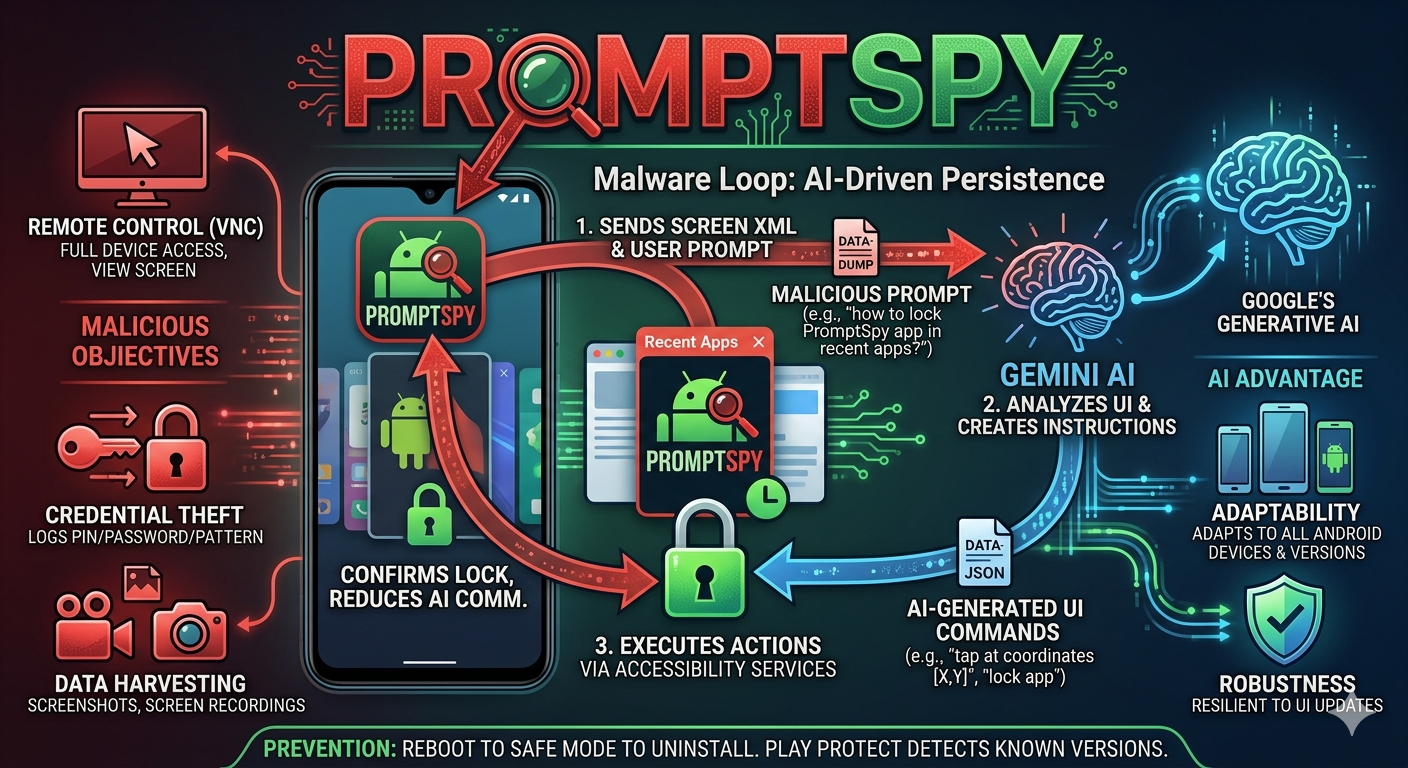
One of the most alarming disclosures in the report involves a piece of malware called PromptSpy. Google uncovered this malware that uses Gemini to autonomously navigate Android devices by interpreting on-screen activity and generating commands in real time. Source: Axios
Let that sink in. This is not malware that steals a password file or intercepts a text message. PromptSpy uses AI to watch what is on your screen, understand what it is looking at, and take action all without any human operator directing it. It is, essentially, an AI agent working against you inside your own phone. I know crazy right?
3. Nation-State Actors Using AI at Scale
The threat is not limited to independent cybercriminals. Researchers found APT45, a North Korean military group, using AI to test and validate thousands of exploits targeting software flaws. China-linked state actors are doing the same. What this means in practical terms is that government-backed hacking programs now have AI tools that can probe thousands of systems simultaneously, around the clock, at a cost and scale that was impossible just two years ago.
What This Means for IT Professionals
If you work in IT whether you are in a help desk role, systems administration, Microsoft Teams administration, or IT management; this report should directly shape how you think about your organization’s security posture.
AI allows attackers to move faster, smarter, and cheaper than ever before. For IT teams, this means the traditional reactive approach to cybersecurity is no longer sufficient. Waiting for a known threat signature to trigger an alert is the wrong model when AI-generated malware can rewrite itself after every execution to avoid detection. Time to be proactive!
Microsoft Teams specifically deserves attention here. As organizations have consolidated their communications onto Teams, it has become an increasingly attractive target. Phishing attacks delivered through Teams chat, credential harvesting through fake Teams login pages, and social engineering via Teams calls are all escalating attack vectors in 2026. Modern phishing emails are no longer riddled with spelling errors as AI can mimic writing styles of real executives or coworkers and personalize messages using scraped social media data. The same applies to Teams messages.
7 Things You Should Do Right Now
In No Order of Importance
1. Upgrade From SMS-Based Two-Factor Authentication SMS codes can be intercepted through SIM-swap attacks, which AI has made significantly easier to execute. Use a physical security key like YubiKey instead of SMS codes. AI-powered SIM-swap attacks make SMS-based MFA nearly useless against sophisticated hackers. At minimum, switch to an authenticator app like Microsoft Authenticator or Google Authenticator for your most sensitive accounts.
2. Update Everything — Right Now Software updates exist specifically to patch the vulnerabilities hackers exploit. One of the clearest findings from the Google report is that AI dramatically accelerates how fast attackers find and weaponize unpatched flaws. Every day you delay an update is a window of exposure.
3. Use a Password Manager Reused passwords are AI crackers’ best friend. Use Bitwarden or 1Password to generate and store unique 20-plus character passwords for every account. Bitwarden is free and open source. There is no longer any excuse for reusing passwords in 2026.
4. Freeze Your Credit AI-driven identity theft can open new credit accounts in your name within hours. A free credit freeze at Equifax, Experian, and TransUnion stops this instantly. This is one of the most underused and most effective protections available to individuals, and it costs nothing.
5. Check HaveIBeenPwned Regularly Visit HaveIBeenPwned.com monthly to check whether your email address or passwords have appeared in known data breaches. Set up free alerts so you are notified immediately if your credentials surface in a new breach.
6. Be Skeptical of Everything in Microsoft Teams and Email Given what we know about AI-generated phishing, train yourself and your team to verify any unusual request through a secondary channel before acting on it. If someone messages you in Teams asking for credentials, a payment, or access call them directly to confirm. That extra 60 seconds can prevent a catastrophic breach.
7. Use Next-Generation Antivirus Traditional antivirus software cannot detect AI-generated malware. You need next-generation endpoint protection tools that use behavioral analysis and AI themselves, such as CrowdStrike Falcon, SentinelOne, or the premium version of Malwarebytes. For individuals, Malwarebytes Premium is an affordable starting point.
The Bigger Picture for Your Tech Career
Here is something worth sitting with: the Google report is not just a threat advisory but it is a career opportunity signal for IT professionals.
Organizations everywhere are scrambling to understand and respond to AI-powered threats. IT specialists who can speak intelligently about AI security, implement modern endpoint protection, and train their colleagues to recognize AI-generated social engineering are going to be in extremely high demand over the next three to five years. Microsoft’s Security Copilot, built into the Microsoft 365 ecosystem, is specifically designed to help IT teams respond to this new threat environment and knowing how to deploy and manage it is already a differentiating skill.
The defenders who survive and thrive will be those who adopt AI-powered countermeasures, implement Zero Trust architecture, and build human teams trained to recognize AI-generated deception. That is your career runway right there.
Final Thoughts
The Google report published about AI Hacking in 2026 this week is not a warning about the future. It is a description of the present. AI-powered hacking is not coming as it is here today, it is scaling, and it is specifically targeting the systems and platforms that everyday people and organizations rely on.
The best response is not panic. It is preparation. Update your software, upgrade your authentication, use a password manager, and stay informed. As an IT professional, make this the week you take your personal and organizational cybersecurity posture seriously because the threat actors already took theirs seriously months ago.
Stay sharp out there.
Muss Sterrett is an IT Specialist with hands-on experience in cloud apps, enterprise technology, and AI-powered productivity tools. He writes about tech careers, emerging AI tools, and the intersection of technology and human performance. Follow along for weekly insights on https://www.musssterrett.com and connect on [LinkedIn].